
Ball don't lie
Subjects discussed: The New York Knicks, the Chicago Bulls, the pursuit of happiness itself

This is a newsletter about basketball and my feelings about basketball, and if you don’t care about either then please feel free to skip. But don’t say I didn’t warn you.
Over the last few weeks, just about every basketball fan I know has reported a mild obsession with 82-0, an NBA trivia game that broke containment within hours of popping up online. The premise is simple, and wildly addictive: You’re given a limited number of attempts to construct an NBA roster capable of remaining undefeated over an entire season. The pool of available players is subdivided by team and decade, and the game’s fun is trying to draw the right player at the right moment in his career. 82-0 and its spinoffs test the user’s hoops knowledge—any moderate ball knower will understand why Michael Jordan and Kobe Bryant shouldn’t play together, for example—but really they’re an excuse to wax nostalgic. An old joke goes that all men need to do, in order to have a good time, is sit around and name retired athletes—and, yeah, alright. Last Sunday, a high school friend informed me of the healthy birth of his daughter, and also the perfect team he’d assembled that afternoon.
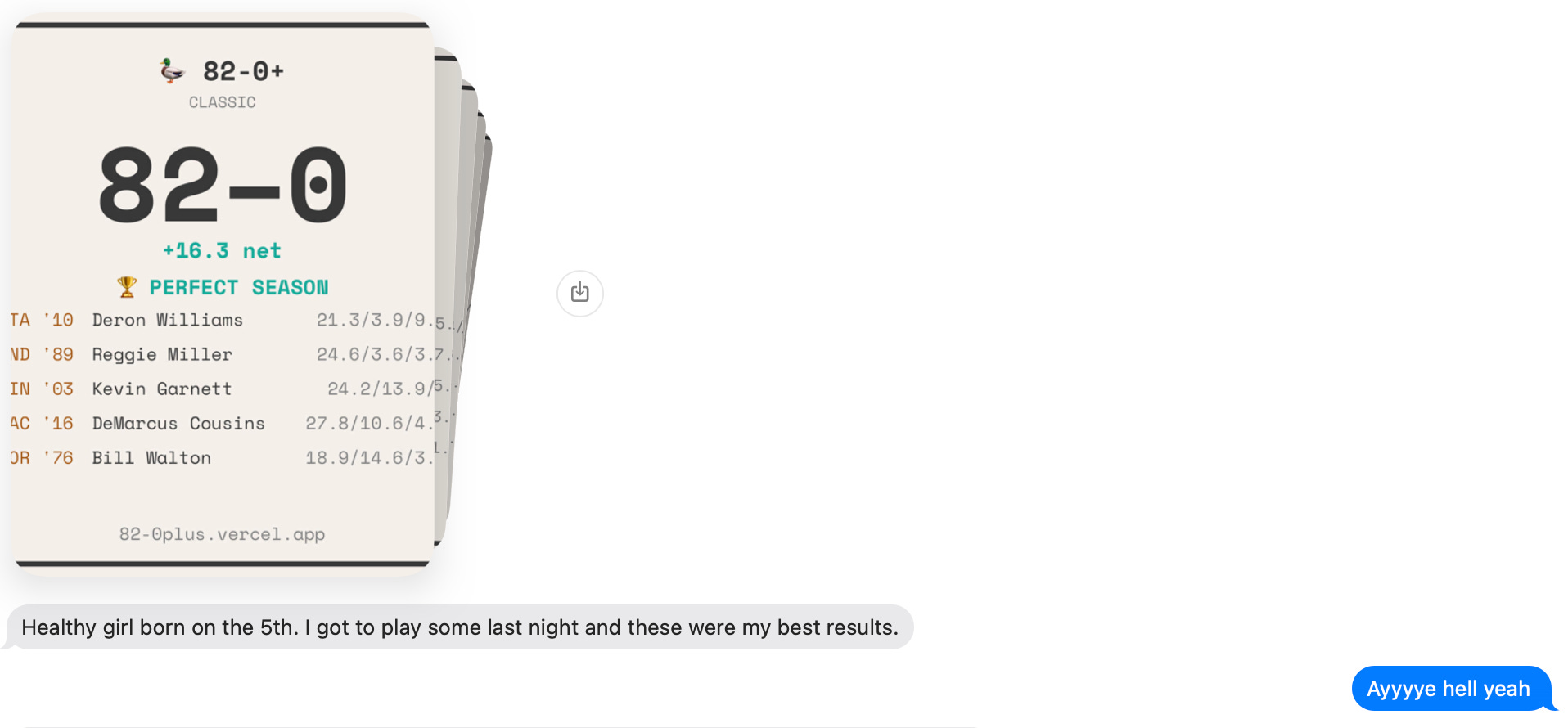
Basketball fandom, like other sports fandoms, is accretive. The attentive fan is made specifically and ambiently aware of dozens of players every year, filing their play styles and personalities and habits and actions (positive, negative, idiosyncratic, inexplicable) into an internal database labeled HOOPS FACTS. It’s not important or useful that I know how Hedo Turkoglu reinvented himself as a stretch 4 on the late ‘00s Orlando Magic; it’s just something I know. Scrolling through the thousands of individual seasons catalogued on 82-0, I hunted for the obvious stars (‘90s Michael Jordan, ‘00s LeBron James) but also used my vestigial “remember when” knowledge re: certain teams and eras to assemble some unconventional yet effective rosters. Kirk Hinrich, Mike Conley, Andrei Kirilenko—these are guys who I like to envision playing perfect basketball. They aren’t even particularly obscure players, but there’s literally no reason why any non-NBA fan would have heard of them.
This time-sucking excuse to think about all eras of the NBA, and the players who’ve come and gone, has perfectly coincided with the NBA Finals, which—as of this weekend—are over, resulting in a new champion: the New York Knicks, victorious for the first time since 1973. One needs only a moment to calculate all the thousands (millions?) of fans who’ve waited a half-century for the good news, many of whom died waiting. I’m loathe to indulge generalizing cliches like “the city has a different energy,” but it’s true that people are very happy. Saturday night was the first time since Donald Trump lost re-election in 2020 where I heard sustained screaming and car-honking on the street (excepting intentional mass gatherings like parades and marathons). The Puerto Rican Day Parade was on Sunday, too, and the Venn Diagram of excited parties was a perfect circle. Okay, so maybe the city has a different energy; even some of my most lit-snob friends, who would normally never be caught dead appreciating a sportsball, have filmed videos from the bar.
But to be honest—to be really, really honest—I haven’t felt anything about the win, and that lack of emotion has distressed me all week. On Wednesday night, just after midnight, I woke up1 to see the Knicks had completed the largest comeback in Finals history to take a decisive 3-1 series lead, and experienced what can only be described as a minor panic attack, where my body went slimy and my brain fired up dozens of irrepressible hot-wire thoughts abating only when, as I tried to calm myself by reading a novel in the living room, our cat took a giant shit on the floor, brute-forcing a shift in attention. In that moment I was thinking about how happy Knicks fans must be, and also how locked-out I was from those feelings, and this despite my living in New York for the last 14 years and planning to do so for the rest of my life (fingers crossed). My anhedonic inability to enjoy something so uncomplicatedly enjoyable—it freaked me out, as someone who’d like to enjoy things instinctively.
The happiest I’ve ever been about a sporting outcome—maybe the last time I’ve been truly happy about a sporting outcome, now that I think about it—was the 2016 World Series, where the Chicago Cubs won it all for the first time in over a century. I’d flown back to Chicago to watch the series and, at the conclusion of a wildly up-and-down Game 7, sat there dazed and unbelieving as the Cubs made the final out to seal the win. My cousin, with whom I was watching the game, lived near Wrigleyville2 at the time, and shortly after we took to the streets to follow the crowds. Waves of meaning smashed into me, as I navigated the celebration. I was ecstatic about the championship, but also I was thinking about all the people in my life, every relative and friend, who had died before the Cubs could break this century-long winless streak. I was thinking about all of the times I’d earnestly believed the Cubs were going to do it, only to watch them eat shit, and the real sadness I’d felt in those moments. I was thinking about all the players I’d loved who were ultimately not that successful, whose names will be remembered only by the diehards.
Sports are an exercise in delayed gratification—you wait, and you wait, and you wait some more for a good thing to happen, and when it does all that deferred excitement cracks through the ground like a million flowers blooming at once. As I walked through Chicago, a warm feeling sparked and expanded inside my chest, and it kept expanding, and every few minutes I’d wonder why do I feel so good right now, only it was obvious why. I drank a stranger’s tequila; I texted everybody I knew; I joined several singalongs of “Go Cubs Go”; I didn’t get home until like 4 in the morning.
It was a great night. And all of that was physically accessible to me when the Knicks won… only I couldn’t emotionally access it, in any sort of genuine way.
The most obvious reason why is that I still identify as a Bulls fan, even though I haven’t lived in Chicago in 14 years and the team has been rotten for almost that long. My whole concept of basketball was formed watching Michael Jordan as a child, an experience that’s hung over my entire adult life. Even when the Bulls stink, I think to myself: At least we had Jordan. His teams memorably feuded with the Knicks, and growing up I enjoyed the inversion of this second-city dynamic, where the junior partner was responsible for putting down the big dog.
A few years ago, I was interviewing LL Cool J, and he off-handedly mentioned running into Patrick Ewing at a NYC club during the 1993 playoffs, when the Knicks held a 2-0 series lead over Jordan’s Bulls. As LL told it, he and Ewing grasped each other happily in the club, and exclaimed: Ain’t gonna be no three-peat!3 But the Bulls did win the next four games, and the title shortly thereafter. LL was joyful, telling this story—he was a joyful man in our brief conversation—but my response, as I laughed, was That’s right. That’s how it was supposed to be.
This was in 2020, thinking about events in 1993 that I was barely aware of at the time, being that I was five years old. And yet my instincts still jerked in one direction, activating my dormant Bulls fandom. This type of thing, when it starts early, lasts a long time. All throughout the last week, I’ve seen little kids wearing Michael Jordan and Bulls-branded shirts—this, in Brooklyn, during a Knicks Finals run. It’s never failed to make me smile.
Last week, the coach of the USA soccer team was asked about the growth of soccer in America, and he said the country’s connection to the game will have to develop before it can meaningfully compete with the mega powers.
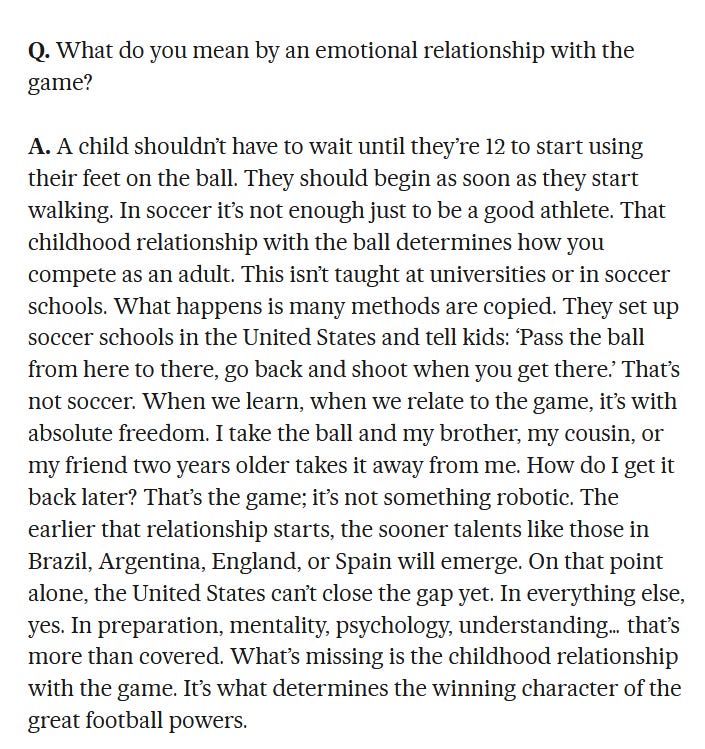
“What’s missing is the childhood relationship with the game. It’s what determines the winning character of the great football powers.” That’s such an eloquent summation of the extra motivation determining how all the best players approach the game—why someone like Knicks guard and NYC native Jose Alvarado seemed to be playing harder during these Finals, because even though he’s a well-paid professional, he remembers his first love. This childhood relationship is also crucial at the spectator level, where fans will spend decades tethered to a particular team through thick and thin just because their dad gave them a sweatshirt when they were three years old.
Hence my difficulty connecting to the Knicks, because that relationship already exists for me… but pondering this made me just as sad, the idea that I’d be denied an adult moment of joy because of some stuff that happened to me when I was little. How unoriginal—the stuff of so many therapy sessions and literary novels. I’d like to think I’m still capable of new feelings, only here was evidence I’m not, and that like everyone else my behavior was hard-wired into me as a child.
Then again, so many of my friends and acquaintances, some of whom retain endearing connections to their childhood team of choice, seemed to have no issue hopping on the bandwagon and enjoying the party. These people, I hope it’s not insulting to say, don’t follow basketball all that closely. Yet it didn’t matter that they couldn’t have named a single player before a month ago, or that they’d never agonized through the doldrums of Chris Duhon and Frank Ntilikina—they were out in the streets, at the bars, seemingly celebrating with as much passion as the long-suffering. Maybe it’s because their fandom was so nascent that they were able to form and cement this deeper connection right when it was most rewarded… and that was also depressing to think about. I’d paid attention to the NBA for so long, but the reward for this close reading—these many HOOP FACTS I’d learned and pondered over the years, allowing me to master a game like 82-0—was a front row seat to the fun, watched behind a three-foot-thick pane of glass4.
In other words: I’d watched too much basketball to enjoy basketball. And maybe that meant I’d wasted all that time, because if my dutiful and sustained fandom had inadvertently ended up preventing this kind of quick-dry emotional coupling with a meaningful Knicks team… then, well, perhaps I’d just played myself.
Ahead of the weekend, my friend Jordan coyly complimented me on being the only one of our friends who wasn’t posting Knicks propaganda, because he knows I’m a Bulls fan just as he’s a Miami Heat fan, and some boundaries can’t be so easily crossed. I appreciated this, though I wasn’t even consciously abstaining. But it was good to be reminded that my feelings didn’t stem from any bitterness, any performative need to play the sour puss or fun ruiner. I just wasn’t moved. I wanted to save the celebratory moment for a team I could fully appreciate in that marrow-deep way, where all that nervy expectation evolves into something beautiful. This wasn’t the case, and while it would’ve been nicer to be free as a bird, I’ve said it before: That’s just the way life goes.
Yet I don’t want to be bounded to my own perception, my own experience. I don’t relish my own moody distance from a happy crowd, because while I am a novelist, I’m not a teenager. Almost always I’m thinking to myself: What am I not seeing, what am I not getting? How can I make it connect? So I tried to think about the Knicks win outside myself: not the bandwagoners, or the braying young men eager to riot across Manhattan, but the long-time committed fans like my friend Robert, who watched so much bad basketball en route to this climactic triumph. I thought about players like Knicks center Karl-Anthony Towns, a conscientious young man whose mother died in the early days of COVID, and who has talked openly about seeing this whole run as a tribute. I thought about their happiness, and I was happy.
It was not the same, or as good, or as deep, as the happiness I might have felt for myself. But it was real, which is not nothing, and all I can ask for.
As a reminder
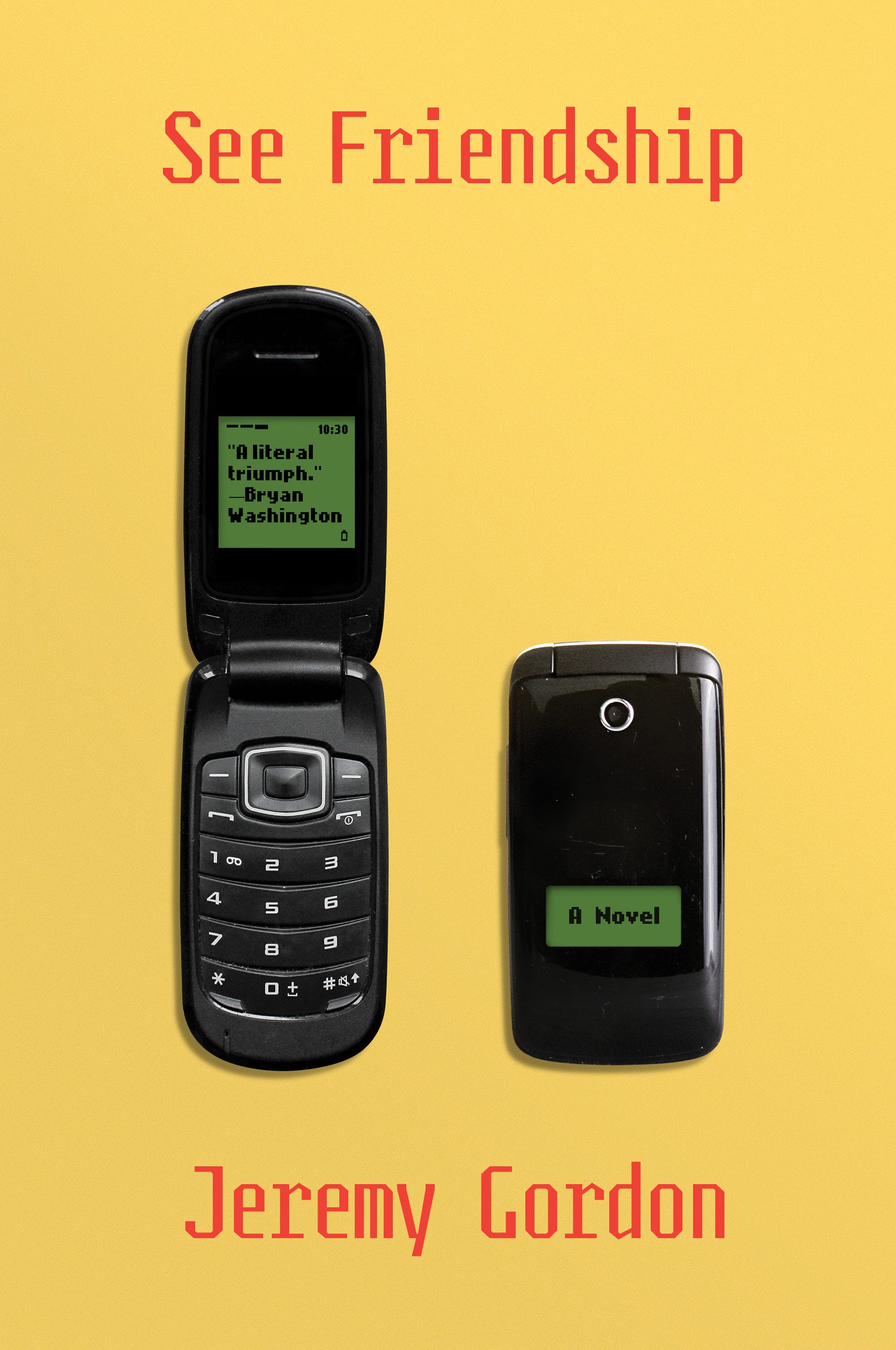
My novel, See Friendship, has been out for a year and change. There’s some stuff about the Bulls in there, of course. You can purchase it here.
I’ve been going to sleep and waking up really early to work on my novel draft, which has worked about 68% of the time.
The neighborhood where the Cubs play at their stadium, Wrigley Field.
The Bulls had won the title in the past two seasons; if the Knicks knocked them out, they would be denied a third consecutive title, otherwise known as a three-peat.
I suppose I could’ve faked it, or brute forced the issue by attending a watch party; we just watched the Mad Men episode where Lane pretends to care about the World Cup in order to ingratiate himself with his fellow English ex-pats. Lane, of course, hangs himself later that season.